Leveraging AI to Enhance Art Education
This project aims to develop an AI-powered system that supports inquiry-based learning during art museum visits this project aims to develop an AI-powered system that supports inquiry-based learning during art museum visits, evaluate its impact on art students’ learning outcomes, and investigate its acceptance by artists and museums.
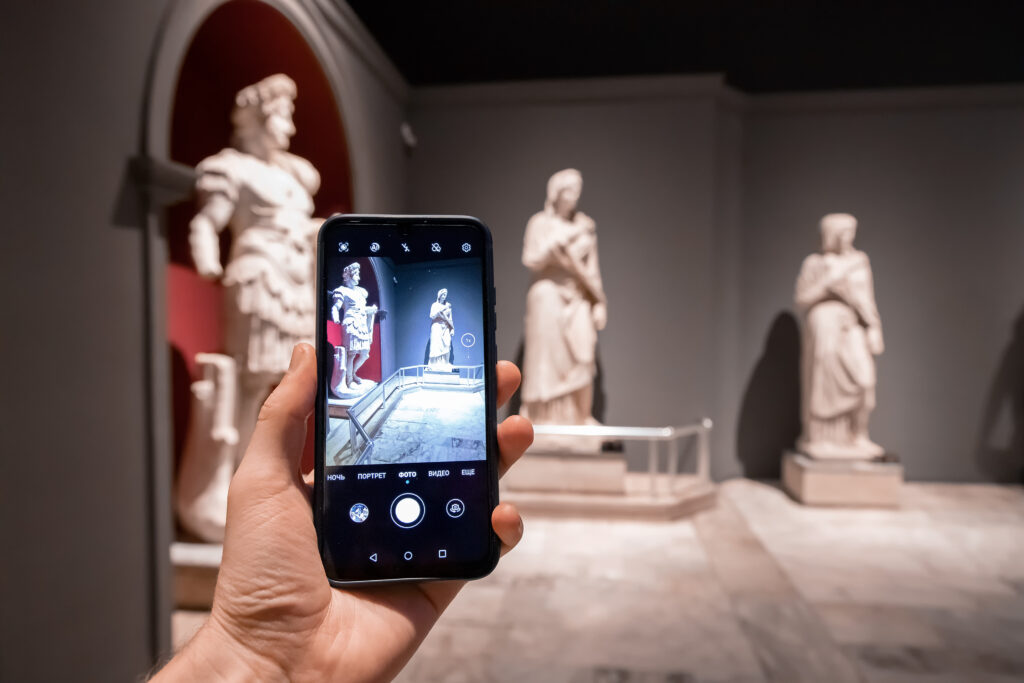
Learning experiences in museums significantly enhance the arts education that students receive in school, fostering creative thinking, critical analysis, and empathy [1, 2]. However, the current approach in many art museums and exhibitions restricts visitors’ ability to fully understand the artists and their works. Art museums often provide minimal contextual information about artworks, as curators prioritize aesthetic experience over detailed labeling [3]. Consequently, learning about artworks and artists often takes place outside the museum, which can diminish the overall learning experience [4, 5]. The challenge is even greater with new, unfamiliar, and underrepresented artworks and artists, whose work may be less recognized.
In response, researchers have developed systems such as virtual guides [6, 7, 8 ] and robots [9 , 10] and implemented in the museums. These solutions, however, lack the ability to engage visitors in more extensive dialogue or support inquiry-based learning [ 11], limiting deeper exploration and critical thinking about the artwork in the exhibition. Recently, museums have begun leveraging advancements in Large Language Models (LLMs) to enhance art education within museum settings. For example, IBM Brazil developed A Voz da Arte (”The Voice of Art”), an Artificial Intelligence (AI)-driven system that utilizes data from museum archives, news sources, and the internet to answer visitor inquiries about artworks [12]. While these systems are effective at engaging visitors, their reliance on online data (e.g., [12]) can potentially lead to AI hallucinations [13 ] that can misrepresent artists and their work, hindering learners’ ability to accurately understand both the artwork and the artist. To address these challenges, this project aims to develop an AI-powered system that supports inquiry-based learning during art museum visits and evaluate its acceptance by artists and museums as well as its impact on art students’ learning outcomes.
Publication
Raju Maharjan, Ainsley J. Overheul, Wonga Nogwanya, and Gino Ndiko. 2026. Artists’ Perspectives on an AI-Powered System for Enhancing Art Exhibitions. In Companion of the 2025 ACM International Joint Conference on Pervasive and Ubiquitous Computing (UbiComp Companion ’25). Association for Computing Machinery, New York, NY, USA, 1399–1403. https://doi.org/10.1145/3714394.3756259
References
- Amanda Krantz and Stephanie Downey. Thinking about art: The role of single-visit art museum field trip programs in visual arts education. Art Education, 74(3):37–42, 2021.
- Emilie Sitzia. The ignorant art museum: beyond meaning-making. International journal of lifelong education, 37(1):73–87, 2018.
- Nina Simon and Shelley Bernstein. Museum 2.0. Acesso em, 12, 2006.
- Juan Gabriel Brida, Chiara Dalle Nogare, and Raffaele Scuderi. Learning at the museum: Factors influencing visit length. Tourism Economics, 23(2):281–294, 2017.
- John H Falk. Viewing art museum visitors through the lens of identity. Visual Arts Research, 34(2):25–34, 2008.
- Timothy W Bickmore, Laura M Pfeifer Vardoulakis, and Daniel Schulman. Tinker: a relational agentmuseum guide. Autonomous agents and multi-agent systems, 27:254–276, 2013.
- Stefan Kopp, Lars Gesellensetter, Nicole C Kr ¨amer, and Ipke Wachsmuth. A conversational agent as museum guide–design and evaluation of a real-world application. In Intelligent Virtual Agents: 5th International Working Conference, IVA 2005, Kos, Greece, September 12-14, 2005. Proceedings 5, pages 329–343. Springer, 2005.
- William Swartout, David Traum, Ron Artstein, Dan Noren, Paul Debevec, Kerry Bronnenkant, Josh Williams, Anton Leuski, Shrikanth Narayanan, Diane Piepol, et al. Ada and grace: Toward realistic and engaging virtual museum guides. In Intelligent Virtual Agents: 10th International Conference, IVA 2010, Philadelphia, PA, USA, September 20-22, 2010. Proceedings 10, pages 286–300. Springer, 2010.
- Masahiro Shiomi, Takayuki Kanda, Hiroshi Ishiguro, and Norihiro Hagita. Interactive humanoid robots for a science museum. In Proceedings of the 1st ACM SIGCHI/SIGART conference on Human-robot
- interaction, pages 305–312, 2006.
- Rachel Gockley, Allison Bruce, Jodi Forlizzi, Marek Michalowski, Anne Mundell, Stephanie Rosenthal, Brennan Sellner, Reid Simmons, Kevin Snipes, Alan C Schultz, et al. Designing robots for long-term social interaction. In 2005 IEEE/RSJ International Conference on Intelligent Robots and Systems, pages 1338–1343. IEEE, 2005.
- John Dewey. Democracy and education. Columbia University Press, 2024. Diego Ricca and Clice Toledo de Sanjar Mazzilli. Intera c¸ ˜ao e cognic¸ ˜ao na construc¸ ˜ao de conhecimentoem museus: o projeto a voz da arte. Estudos em Design, 26(3), 2018.
- What are ai hallucinations? https://www.ibm.com/topics/ai-hallucinations. Accessed: 2024-10-03.